Average Reviews:

(More customer reviews)Are you looking to buy Learning and Not Learning English: Latino Students in American Schools (Language and Literacy Series)? Here is the right place to find the great deals. we can offer discounts of up to 90% on Learning and Not Learning English: Latino Students in American Schools (Language and Literacy Series). Check out the link below:
>> Click Here to See Compare Prices and Get the Best Offers
Learning and Not Learning English: Latino Students in American Schools (Language and Literacy Series) ReviewIt's half novel, half research; the story of four recently-arrived Latino teenagers and their journey through American junior-high's and high school's.All I felt after reading this book was guilt. Guilt at my own ignorance and guilt at the way American schools keep immigrant Latino kids out of the mainstream of our social and economic system.
It seems as if the four kids in Valdes study never had a chance. Their teachers fed them dull, repetitive drills suitable for eight year olds. Their parent's work ethic made them orphans for most of the day, fresh meat for the Surenos and Nortenos. Their `sheltered classes' isolated them from the very English language they needed to compete in the mainstream society. Even the `good' girl who made it all the way to a high school diploma was told she couldn't enroll in a junior college without more repetitive, enervating remedial classes.
The research component of this book was what made it so powerful for me and took it beyond a simple story of four kids struggling to make it in U.S. society. Valdes, to her credit, documents test results to show exactly how far each student progressed (or failed to progress) in two years. It made me realize how vast is the gulf separating immigrant youngsters from the American middle class.
And by focusing on Latino students I had a chance to see into their lives well enough to gain a little insight into the most confusing aspect of my teaching: why is it that Asian, African and European immigrants outpace Latino students almost without exception? I still don't have the answer to that one but it's clear in Valdes book that most Latino kids can function reasonably well without access to written English (and, to a lesser extent, spoken English).
The other insight I got from Valdes was, ironically, that the success or failure these kids experienced in school was mostly a function of their exposure to English outside school. They spent their day in a Spanish-speaking bubble with few interactions in English. Their opportunities to break out of the bubble seemed to determine to a large extent whether they would be able to become full-fledged Latino-Americans.
If you teach Latino students in an American secondary school I believe you'd find gold in this book.
Learning and Not Learning English: Latino Students in American Schools (Language and Literacy Series) Overview
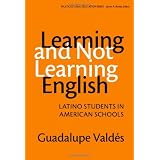
Focusing on the lives and experiences of four Mexican children in an American middle school, the critically acclaimed author of Con Respeto examines both the policy and the instructional dilemmas that surround the English language education of immigrant children in this country. Using samples and analysis of the children's oral and written language as well as an examination of their classrooms, school, and community, this book addresses the difficulties surrounding the teaching and learning of English for second language learners.
This comprehensive volume discusses; classroom activities; the amount of time it takes to "learn" English; how English language learning affects learning in other areas; the consequences of linguistic isolation; and how ESL students are tested. It also presents exclusive data on academic English development at various stages in a two-year process that raise important questions about current ESL teaching policies.
Want to learn more information about Learning and Not Learning English: Latino Students in American Schools (Language and Literacy Series)?
>> Click Here to See All Customer Reviews & Ratings Now

0 comments:
Post a Comment