Average Reviews:

(More customer reviews)Are you looking to buy The Syntax of Spoken Brazilian Portuguese? Here is the right place to find the great deals. we can offer discounts of up to 90% on The Syntax of Spoken Brazilian Portuguese. Check out the link below:
>> Click Here to See Compare Prices and Get the Best Offers
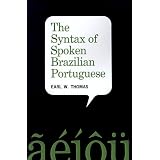
The Syntax of Spoken Brazilian Portuguese ReviewThroughout history, many languages have spread from their homeland to become the "native" language of areas far afield; the whole Romance family of languages shows how Latin became a native tongue far beyond Rome, and the spread of Arabic is similar.Many European languages have been used as "colonial" languages in the past four hundred years, including such unlikely candidates as Flemish and Danish. But really only five European languages have flourished to become native tongues outside of their homelands: French, English, Spanish, Dutch and Portuguese.
The histories of these linguistic developments are varied; some acorns fell farther from the tree than others. Differences in vocabulary and pronunciation are true in every case, and this is to be expected, given that these vary considerably within the mother countries too. But some have also altered grammatically and syntactically. Despite how Parisians may sniff at Canadian French, it really doesn't vary very much syntactically from the standard European variety; where it does, ironically, it is usually the Canadian version that has kept the more antique form while European French has changed. There are, of course, the various French-inpired island creoles, but these are generally not spoken by French who settled overseas, and the dynamic under which they were created is different.
In the case of Spanish, with the exception of some small pockets (as in Aruba) it is amazing how little variation in educated usage there is throughout the world. Even English, despite the fun that Englishmen and Americans poke at each other, hasn't varied nearly as much as it could. It is true that you can discern noticeable differences in educated usage between London and New York, but leaving the USA aside, educated grammar and syntax are virtually identical for the rest of the English speaking world, whether you're in London, Capetown, Sydney, Auckland or (arguably) even Toronto.
Dutch is at the other end of the spectrum; its South African stepchild, Afrikaans, departs so much from European usage that it is recognized as a separate language. Portuguese is not too far behind. The differences in even educated usage between Portugal and Brazil are so extensive that it sometimes amazes me that people from the two countries can understand each other at all. It affects usage of pronouns, verb tenses (the future tense virtually doesn't exist in Brazilian Portuguese), word order and a host of other things, in addition to the usual departures in pronunciation and vocabulary. The departure from the original, in this case, anyway, seems to be on the colony's side; Brazilian Protuguese has changed so much in this past century that even writings by Brazilian writers from 100 years ago sound archaic to modern Brazilian ears.
This book is an attempt to tabulate those differences and present them to the student, and its content is extensive. However, the book is quite difficult to use in any way except as a bookshelf reference; unless you know exactly what you're looking for, you won't find it. The book is split into topics by different syntactical "phenomena", but the information you want could be anywhere.
In the balance, I'm glad I have the book, but you can't use it as a study aid as I wished to, unless you want to memorize large numbers of sentences as usage models. It's probably more useful to the teacher than the student.The Syntax of Spoken Brazilian Portuguese OverviewIncreased personal contact among people of all parts of the world has underscored the inadequacy of traditional language study to meet contemporary communications needs.Linguistic science, in recent years, has responded to this breakdown of communications by emphasizing spoken, versus literary, language in the teaching of foreign languages.Very real differences do exist between what is spoken and what is written in virtually every language.In Brazilian Portuguese, especially, the gulf between the two is wide: In many cases, the most cultured Brazilian is unable to comprehend with ease Brazilian literature written only fifty years ago.THE SYNTAX OF SPOKEN BRAZILIAN PORTUGUESE is the first thorough analysis of the spoken language of contemporary Brazil, in English, for students and teachers of the language.Useful as a text in advanced language courses, the work is intended primarily for reference and as a research aid to future authors of Portuguese language textbooks.
Want to learn more information about The Syntax of Spoken Brazilian Portuguese?
>> Click Here to See All Customer Reviews & Ratings Now

0 comments:
Post a Comment