Average Reviews:

(More customer reviews)Are you looking to buy The Interactional Instinct: The Evolution and Acquisition of Language? Here is the right place to find the great deals. we can offer discounts of up to 90% on The Interactional Instinct: The Evolution and Acquisition of Language. Check out the link below:
>> Click Here to See Compare Prices and Get the Best Offers
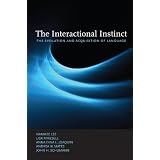
The Interactional Instinct: The Evolution and Acquisition of Language ReviewFor years I have questioned the theories of Chomsky and innatists in general, mainly because the examples they provided never made sense to me and didn't seemed steeped in what we can observe in actual speakers. This book clearly outlines why people speak, and why language cannot be innate. Basically, from the moment we are born humans have a drive to communicate with others due to an extremely complex reward system which is activated during nursing and mother/infant bonding. Because of the release of opiates during interactions, infants are "rewarded" by communicating with caregivers, due to the morphine-like effects of these opiates. Therefore, as infants we are driven to communicate in order to continue receiving these rewards. The structure of language develops not due to innate structures, but due to interacting factors explicable by viewing language as a complex adaptive system, similar to ant colonies, weather patterns, and traffic jams. In a complex adaptive system, a structure emerges through chaos. We have historical evidence of this happening in language though pidgins becoming creoles, and through the grammaticalization process that occurs in historical language change. There is a lot more to this book than what I have mentioned, and it is an essential read for those interested in the neurobiological underpinnings of language.The Interactional Instinct: The Evolution and Acquisition of Language OverviewThe Interactional Instinct explores the evolution of language from the theoretical view that language could have emerged without a biologically instantiated Universal Grammar. In the first part of the book, the authors speculate that a hominid group with a lexicon of about 600 words could combine these items to make larger meanings. Combinations that are successfully produced, comprehended, and learned become part of the language. Any combination that is incompatible with human mental capacities is abandoned. The authors argue for the emergence of language structure through interaction constrained by human psychology and physiology. In the second part of the book, the authors argue that language acquisition is based on an "interactional instinct" that emotionally entrains the infant on caregivers. This relationship provides children with a motivational and attentional mechanism that ensures their acquisition of language. In adult second language acquisition, the interactional instinct is no longer operating, but in some individuals with sufficient aptitude and motivation, successful second-language acquisition can be achieved. The Interactional Instinct presents a theory of language based on linguistic, evolutionary, and biological evidence indicating that language is a culturally inherited artifact that requires no a priori hard wiring of linguistic knowledge.Want to learn more information about The Interactional Instinct: The Evolution and Acquisition of Language?
>> Click Here to See All Customer Reviews & Ratings Now

0 comments:
Post a Comment