Average Reviews:

(More customer reviews)Are you looking to buy Kosovo Crossing: American Ideals Meet Reality On The Balkan Battlefields? Here is the right place to find the great deals. we can offer discounts of up to 90% on Kosovo Crossing: American Ideals Meet Reality On The Balkan Battlefields. Check out the link below:
>> Click Here to See Compare Prices and Get the Best Offers
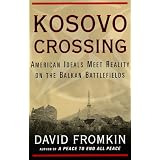
Kosovo Crossing: American Ideals Meet Reality On The Balkan Battlefields ReviewWhat would a book with the title "Kosovo Crossing: American Ideals Meet Reality in the Balkan Battlefield" be about? You may think it will be about the 1999 Kosovo war and its aftermath - I certainly did. But you will be, as I was, mistaken.The first one hundred pages of 'Kosovo Crossing' are a discussion of American foreign policy from Theodore Roosevelt to George Bush sr., with an emphasis about military intervention abroad.
The next 50 pages are a history of the Balkan, from Roman times and up to the end of Tito's regime, with a special focus on the Post WW1 era. It is a topic author David Fromkin clearly knows much about, as the author of the brilliant study of the collapse of the Ottoman Empire A Peace to End All Peace: The Fall of the Ottoman Empire and the Creation of the Modern Middle East.
But it is not the Kosovo war, nor really its near history - that would only come in the last 50 pages, and even then, the discussion is less about the Kosovo war then about the power and limitation of American Interventions. It is telling when the line "Kosovo is a province of 4,200 square miles in southern Serbia, slightly smaller than the state of Connecticut" appears on page 158!
The two books of Fromkin I have previously read included the brilliant, carefully research and wonderfully written 'A Peace to End All Peace', an all time classic about the fall of the Ottoman Empire and its aftermath, and 'The Way of the World', a well written but unspectacular outline of human history. Unfortunately, Kosovo Crossing is much more like the latter then the former - indeed, it does not even reach the highlights of 'The Way of the World'.
That is not, however, for the lack of clear writing. Fromkin should serve as a model for most historians and columnists. See his description of the rational of American Interventions:
'It was FDR, and not John Donne, who was vindicated by history. "Any man's death diminishes me, for I am involved in mankind", wrote the seventeenth century poet, and while it is true that sometimes another person's dying is like a bit of one's self dying, too, it isn't always like that. Most of the times it makes good sense to ask for whom the bell tolls.' (p. 167)
The bulk of Fromkin's book is calling against humanitarian interventions. Fromkin believes that America should intervene only when its vital interests are at risk (pp. 168-169). Fromkin is not sanguine about the suffering of the Albanians who have gone through "ethnic cleansing", but his solution is bizarre; Fromkin argues that the US and the EU should allow the refugees to settle in them. (pp. 182-182).
There are two immediate problems with this idea:
First, it is a political impossibility; As Peter Novick argues in The Holocaust in American Life, political obstacles are no less real then technical ones; No matter how high spirited or moral a President of the United States will be, accepting millions of refugees is bound to be beyond his powers.
Second, and no less important, is that this will of course only encourage ethnic cleansing - indeed, might paradoxically lead to a moral case in favor of ethnic cleansing! Indeed, why must Palestinian refugees live in poverty in Israel, Lebanon and Jordan? Why not send them to America? Indiscriminate acceptance of refugees is bound to make the world more hospitable to war, massacres and ethnic cleansing.
The Palestinian example reminds us of an even more basic fallacy in Fromkin's account: Ethnic cleansing does not always solve ethnic conflicts, despite his claim that "If the US and NATO had not intervened, the Serbs would have settled the Kosovo issue, by ethnic cleansing. The Kosovars would have been pushed into Albania and forcibly reunited with their own people. Kosovo would be owned and inhibited exclusively by Serbs. Monstrous though it would have been to let the Milosevic regime profit from its crimes, it would all be over." (p. 190). I'm afraid that I don't necessarily share Dr. Fromkin's belief in the assured success of ethnic cleansing.
As a book about American intervention in the world, Kosovo Crossing has been rendered somewhat obsolete by 9/11. His skepticism about NATO's role in Kosovo also looks, five years down the road, at least partially overstated. In comparison with the wars in Iraq and Afghanistan, Kosovo looks like the very model of American interventions.
David Fromkin wrote an interesting and well written book. At 5.99 U$, it is truly a catch. But I do wish that Fromkin's pen will turn again to something more ambitious.Kosovo Crossing: American Ideals Meet Reality On The Balkan Battlefields Overview
Want to learn more information about Kosovo Crossing: American Ideals Meet Reality On The Balkan Battlefields?
>> Click Here to See All Customer Reviews & Ratings Now

0 comments:
Post a Comment