Average Reviews:

(More customer reviews)Are you looking to buy Language Change: Progress or Decay (Cambridge Approaches to Linguistics)? Here is the right place to find the great deals. we can offer discounts of up to 90% on Language Change: Progress or Decay (Cambridge Approaches to Linguistics). Check out the link below:
>> Click Here to See Compare Prices and Get the Best Offers
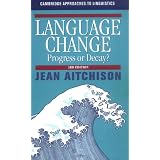
Language Change: Progress or Decay (Cambridge Approaches to Linguistics) ReviewWhile it's title might make the book seem a collection of papers taking sides in a debate, LANGUAGE CHANGE: Progress or Decay is a textbook written by Jean Aitchison introducing contemporary study of language change to beginning students of linguistics. The book has proven quite popular for its gentle tone and its clear summarization of important work in the field, and is now in its third edition.This reviewer is a graduate student of historical linguistics, and I've several years of experience in the field. For all its simplicity, however, Aitchison's book was relevatory. Those with training in the Indo-European or Uralic language families tend to think of language change as some abstract sequence of events that are cleanly reconstructed with the comparitive method. Our traditional handbooks are rather divorced from contemporary research and don't consider the "why" and "how" of language change. Aitchison remedies this by considering language as a product of human beings, with all of their social pressures and insecurities. She first presents the work of William Labov, who viewed language change in progress in 20th-century new York. His work tells us about how varying standards of pronunciation in a given population spread or die depending on social prestige.
Another matter this student of historical linguistics was unclear about is exactly why sounds tend to change along the same lines in all language families. Everyone knows that final consonants tend to be lost, labiovelars stops may become /p/ or /b/, and /l/ often shifts to /w/. Aitchison explains the physical causes for these common phonetic and ultimately phonological changes. By far the most rigorous and useful chapter for me was "The Mad-Hatter's Tea Party", an admirably easy-to-grasp explanation of push chains and drag chains with plenty of examples.
As for the question in the subtitle, Aitchison ceaselessly stresses that language change is natural and unavoidable. She quotes from a long line of English-language purists, from Jonathan Swift to William Safire to show the absurdity of seeking to freeze language at a given moment. At the same time, she emphasises that languages do not evolve towards some ideal, but rather endlessly wheel about from one configuration to another.
I highly recommend this book to any student of historical linguistics. Even if you have some training in the field, you're bound to find something new and exciting in Aitchison's text.Language Change: Progress or Decay (Cambridge Approaches to Linguistics) OverviewThis book gives a lucid and up-to-date overview of language change, discussing where our evidence about language change comes from, how and why changes happen, and how languages begin and end. It considers both changes that occurred long ago, and those currently in progress. This substantially revised third edition includes two new chapters on change of meaning and grammaticalization. New sections have been added to other chapters, as well as over 150 new references. The work remains nontechnical in style and accessible to the reader with no previous knowledge of linguistics.
Want to learn more information about Language Change: Progress or Decay (Cambridge Approaches to Linguistics)?
>> Click Here to See All Customer Reviews & Ratings Now

0 comments:
Post a Comment