Average Reviews:

(More customer reviews)Are you looking to buy The Knowledge Deficit: Closing the Shocking Education Gap for American Children? Here is the right place to find the great deals. we can offer discounts of up to 90% on The Knowledge Deficit: Closing the Shocking Education Gap for American Children. Check out the link below:
>> Click Here to See Compare Prices and Get the Best Offers
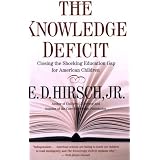
The Knowledge Deficit: Closing the Shocking Education Gap for American Children ReviewI am an immigrant to the US and I agree that America has serious problems with its educational system. According to the NAEP, most of America's children are not proficient in reading, math or science. I remember reading somewhere that Massachussetts was number 1 in reading even though only 43 percent of kids were proficient. American schools aren't just failing the poor. They are failing kids from all economic backgrounds. Even many high achieving students are poorly educated when compared to their peers in other nations.I have been bewildered by the failure of American education. With two children of my own, I wanted to find out what the problem is. Unfortunately, a lot of books about the failures of education are written by people on the right. Many of these books have an anti-public education perspective. But public education works well in many countries, so government run schools is not the problem. Books like "Smart Kids, Bad Schools" have interesting ideas but their fixes definitely won't solve the overall problem. When I read this book, I knew I had the answer. Hirsch's views are common sense and are based on the kinds of things that work in other countries and in many private and charter schools.
I was educated the way Hirsch suggests. I started school at 4 and learned to read and write. At 6, I learned several subjects, including geography, history and science using the coherent and cumulative approach Hirsch suggests. Hirsch says that the problem in this country is not that kids aren't learning content. He says the problem is that it is not coherent and cumulative. He says that there is no standard curriculum, so students are often reading the same books or learning the same concepts in multiple grades.
Hirsch makes the point that kids will never be able to read well without the background knowledge that is assumed by the text. Rather than teaching background knowledge schools are instead teaching "comprehension strategies," such as finding the main idea, predicting, inferencing and other nonsense. Anyone with common sense would know that this can never work. If you have no background knowledge in astrophysics, all the comprehension strategies in the world won't help you understand an astrophysics text.
Hirsch says that the sooner you start teaching this background knowledge the better. Years of cumulative study in a wide variety of subjects will give kids much of the background knowledge they will need. Instead schools give children reading assignments that either cover things they already know (such as going to school, the playground, etc.) Or they introduce content in a piecemeal way. So, children don't build up a strong understanding of a topic and soon forget it.
Hirsch says that in other countries, most children are at a similar level by 4th grade. In America, variances in children's abilities increase the longer they are in school. Teachers are left with the almost impossible task of teaching children that run the spectrum from remedial to advanced. I agree with Hirsch on this. When I was at school, most children were at the same level. Teachers could teach the same content without having to customize lessons for multiple skill levels.
Hirsch recommends a national standard curriculum that should cover half of what children learn. This will benefit children who move to a new school. It will benefit teachers because children will enter their classes with the same level of knowledge. He suggests that states get together to establish this standard curriculum. I'm not sure if this is realistic. At the very least, states should implement standard curriculums that establish what children learn and when they should learn it.
The problem is while Hirsch is right his ideas will not be accepted by the education community where Romantic notions about natural learning and the supposed evils of rote learning dominate. They will not be accepted by ideologues on the left and right who are paranoid about children being "indoctrinated" by the public schools. Concerned parents will either have to engage in homeschooling or afterschooling to ensure that their kids get a solid education. Or they will have to fork over large sums of money to pay for a private school in addition to the property taxes they pay to fund public schools. I couldn't help feeling a little depressed after finishing this book. My eldest child will start school in two years and things definitely won't change by then. So I have to consider alternatives.The Knowledge Deficit: Closing the Shocking Education Gap for American Children OverviewThe Knowledge Deficit illuminates the real issue in education today -- without an effective curriculum, American students are losing the global education race. In this persuasive book, the esteemed education critic, activist, and best-selling author E.D. Hirsch, Jr., shows that although schools are teaching the mechanics of reading, they fail to convey the knowledge needed for the more complex and essential skill of reading comprehension. Hirsch corrects popular misconceptions about hot issues in education, such as standardized testing, and takes to task educators' claims that they are powerless to overcome class differences. Ultimately, this essential book gives parents and teachers specific tools for enhancing children's abilities to fully understand what they read.
Want to learn more information about The Knowledge Deficit: Closing the Shocking Education Gap for American Children?
>> Click Here to See All Customer Reviews & Ratings Now

0 comments:
Post a Comment