Average Reviews:

(More customer reviews)Are you looking to buy When Languages Die: The Extinction of the World's Languages and the Erosion of Human Knowledge? Here is the right place to find the great deals. we can offer discounts of up to 90% on When Languages Die: The Extinction of the World's Languages and the Erosion of Human Knowledge. Check out the link below:
>> Click Here to See Compare Prices and Get the Best Offers
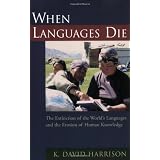
When Languages Die: The Extinction of the World's Languages and the Erosion of Human Knowledge ReviewSeveral people have written about so-called "language death" (David Crystal and Mark Abley have written books on the stubject). But K. David Harrison's book When Languages Die shows what it really means when a language "dies."First of all, Harrison makes it clear the death metaphor isn't perfect. Languages aren't people; they can't die. Instead "language shift - - the process by which younger people in a community choose not to speak the ancestral language and opt for the dominant national language" takes place. Harrison has spent years with, among others, the Tofa and Tuvan people in Siberia (whose Turkic languages have been replaced by Russian) and the nomadic Monchak people in Mongolia, who "have been linguistically fully assimilated to Mongolian."
Harrison uses examples from over a hundred different indigenous languages to show the different ways people have thought about the world.
Harrison points out that it's not so much globalization as urbanization that's responsible for language disappearance: "In crowded urban spaces, small languages usually lose the conditions they need for survival."
Harrison shows why we need to at least document the thousands of languages that will disappear this century. We don't even know what knowledge we'll lose. Language is "sticky" when written down, but most languages have never had writing systems. And if we lose the knowledge of how people have thought, we won't know how people can think.
The saddest story in the book belongs to Vasya Gabov, the youngest speaker of Os ("O" with an umlaut). The Os people fish and hunt in central Siberia. In school Gabov was forbidden to speak his own language and forced to speak Russian. He reacted by inventing an alphabet for Os based on Cyrillic. (Harrison goes into detail about how Gabov made the Russian alphabet work for Os.) Then, once Gabov had a way of recording his native language, he started keeping a journal in Os. But years later, when someone mocked him for writing in Os, the feelings of shame from school came back and he "threw his journal - - the first and only book ever written in his native Os tongue - - out into the forest to rot."
Harrison's telling of Vasya Gabov's story illustrates something that's clear throughout the book - - Harrison may be interested as a scientist in these languages for their own sake, but he cares for the "last speakers" he's lived with as human beings.When Languages Die: The Extinction of the World's Languages and the Erosion of Human Knowledge OverviewIt is commonly agreed by linguists and anthropologists that the majority of languages spoken now around the globe will likely disappear within our lifetime. The phenomenon known as language death has started to accelerate as the world has grown smaller.This extinction of languages, and the knowledge therein, has no parallel in human history. K. David Harrison's book is the first to focus on the essential question, what is lost when a language dies? What forms of knowledge are embedded in a language's structure and vocabulary? And how harmful is it to humanity that such knowledge is lost forever?Harrison spans the globe from Siberia, to North America, to the Himalayas and elsewhere, to look at the human knowledge that is slowly being lost as the languages that express it fade from sight. He uses fascinating anecdotes and portraits of some of these languages' last remaining speakers, in order to demonstrate that this knowledge about ourselves and the world is inherently precious and once gone, will be lost forever. This knowledge is not only our cultural heritage (oral histories, poetry, stories, etc.) but very useful knowledge about plants, animals, the seasons, and other aspects of the natural world--not to mention our understanding of the capacities of the human mind. Harrison's book is a testament not only to the pressing issue of language death, but to the remarkable span of human knowledge and ingenuity. It will fascinate linguists, anthropologists, and general readers.
Want to learn more information about When Languages Die: The Extinction of the World's Languages and the Erosion of Human Knowledge?
>> Click Here to See All Customer Reviews & Ratings Now

0 comments:
Post a Comment