Average Reviews:

(More customer reviews)Are you looking to buy A Natural History of Latin? Here is the right place to find the great deals. we can offer discounts of up to 90% on A Natural History of Latin. Check out the link below:
>> Click Here to See Compare Prices and Get the Best Offers
A Natural History of Latin ReviewHaving ordered this book as a Christmas present to myself, I was eager to see a new treatment of the evolution, growth, and spread of the Latin language. Instead, I received a book that should have been titled "Latin Literature, A PC Summary for Women and Children." This may offend some of you more sensitive types, but you should not be upset with me. My new title for this book is not a joke reflecting any personal bias, but on the contrary, it is an accurate description of the arrogance and soft-bigotry of the author/translators in charge of this waste of foliage. The authors make repeated comparisons of ancient literature to "TV soap operas" and at one point they even absurdly compare Plautus' Menaechmi and Shakespeare's Comedy of Errors to our own Dallas! You remember, 'who shot J.R.?' and all that. This, not my politically incorrect title, should be offensive to your 'sensibilities.' The authors constantly insult the intelligence of their intended audience, all the while attempting to stretch similes and metaphors beyond their means. They repeatedly compare Stoic philosophy to Nazism, Lucretius as a forerunner to Marx, old Roman values as repugnant, and also display a blatant disregard for the value of lost literature in general. Here are two small samples of this reprehensible approach:1. - p.26 - We do know that there were quite a few writers besides Cato and Plautus, whom we have already mentioned, and in particular we have many works by another writer of comedies, Terence. But, as far as we know, the works that have been lost are not terribly many and they were probably not of any great value.
2. - p. 36 - For the most part he [Caesar] marched his army around and fought pitched battles, which makes the narrative rather monotonous, as millions of schoolchildren have discovered, since his account of the Gallic war has quite undeservedly taken up a great deal of time in the traditional Latin syllabus.
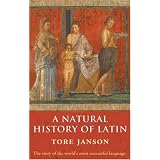
It is not necessarily the particulars of the argument but rather the atmosphere of constant complaining and pessimism which I found to be too much to take. If you're one of those clever nay-sayers who would more than likely happily point out that this is hypocritical of me, then by all means pick up a copy of this book, it's perfect for you. If the selections I chose do not seem to fit with my general point, I will post others in the future. Yes, I read the whole book. Yes, I know that my examples come only from part 1. Which reminds me, the last 122 pages is essentially an extremely poor appendix of Latin grammar and Roman sayings. It would have been more useful to append a juice box so that your kid could have a refreshing drink and have something left over to throw at you for buying this. For those of you who made the difficult decision to stay in school past the tenth grade there is a plethora of good alternatives about Roman culture, history, literature, and language any of which would be better than this one.A Natural History of Latin OverviewNo known language, including English, has achieved the success and longevity of Latin. French, Spanish, Italian, and Romanian are among its direct descendants, and countless Latin words and phrases comprise the cornerstone of English itself. A Natural History or Latin tells its history from its origins over 2500 years ago to the present. Brilliantly conceived, popularizing but authoritative, and written with the fluency and light touch that have made Tore Janson's Speak so attractive to tens of thousands of readers, it is a masterpiece of adroit synthesis. The book commences with a description of the origins, emergence, and dominance of Latin over the Classical period. Then follows an account of its survival through the Middle Ages into modern times, with emphasis on its evolution throughout the history, culture, and religious practices of Medieval Europe. By judicious quotation of Latin words, phrases, and texts the author illustrates how the written and spoken language changed, region by region over time; how it met resistance from native languages; and how therefore some entire languages disappeared. Janson offers a vivid demonstration of the value of Latin as a means of access to a vibrant past and a persuasive argument for its continued worth. A concise and easy-to-understand introduction to Latin grammar and a list of the most frequent Latin words, including 500 idioms and phrases still in common use, complement the work.
Want to learn more information about A Natural History of Latin?
>> Click Here to See All Customer Reviews & Ratings Now

0 comments:
Post a Comment